Introduction to Cataracts
Contents
Is it a film over the eye?
A cataract is the aging of the lens. Yes, I know that sounds confusing – let’s take it step by step. The lens is the part inside your eye that helps focus at different distances. You can see it marked with an arrow in the diagram below. Most often than not, the plurar word is used, thus cataracts.

This lens, as the name suggests, should be crystalline – very transparent. As we age, it loses this transparency. It’s not until a certain age that the lens becomes more brownish and opaque. At that point, we call it a cataract. As it progresses, it can turn black (or more commonly, white.)
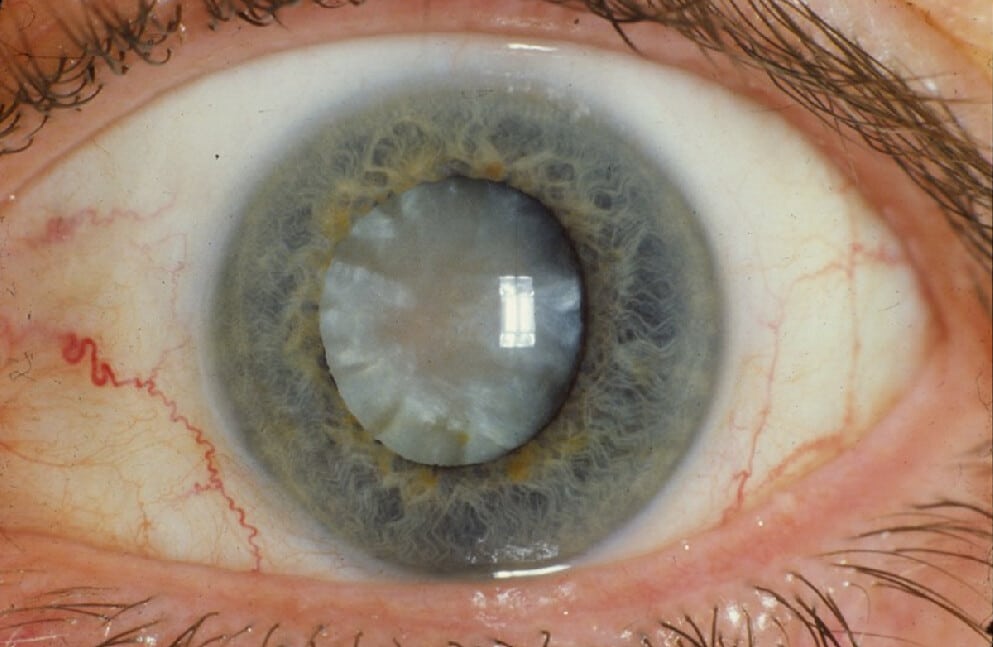
So it’s not a film growing over the eye, right?
No, it’s not. It’s the same lens you’ve always had, just losing its transparency. I’m repeating this because it’s a question we get constantly in the clinic.
Well, that won’t happen to me.
It’s a typical age-related condition. It usually appears after the age of sixty, although it can sometimes show up in younger people or even children. In fact, if you live long enough, you’re almost guaranteed to develop a cataract to some degree.
Can’t glasses fix this, doctor?
No, glasses can help focus images onto the retina, but they can’t make a brown lens clear again. The solution involves surgery.
I see… So you’ll let me know when I need surgery?
Everyone has different visual needs and personal circumstances. Visual requirements vary a lot from one person to another. There’s no single “perfect time” to get the surgery done. Usually, it’s the patient who decides when it’s time. The only exception is when the cataract has advanced so much that it becomes hard, making surgery riskier. If we can predict that will happen in a short term, we prefer to operate earlier.
For example, a professional driver might be very limited with 70% vision, whereas someone else who doesn’t drive might be able to wait longer.

What’s the usual process for a cataract patient?
Typically, the patient comes to the clinic early in the morning. They check in at the front desk, change into surgical clothing, and put on a surgical gown.
Next, they go to the pre-op room. A vein in their arm is accessed (just in case medication is needed), they’re given a relaxing pill, and their vitals are taken. Then the eye prep begins: anaesthetic drops and a small pill placed under the eyelid to dilate the eye.
A nurse will monitor the dilation. Depending on the surgical schedule, the patient will head to the operating room between one and two hours later. Once there, the doctor usually gives a brief explanation of the procedure. The surgery itself lasts about 10–15 minutes. The patient might feel some pressure or stinging in the eye. Some even see light shows!
Afterward, we cover the eye and return to the prep room. There, the patient rests for 15 minutes with a juice to recover from the experience. Then, they change back into their clothes and head home. It’s recommended to come with someone.
Hey! Wait! You skipped the part about HOW the cataract is removed!
Cataracts are currently removed using micro-invasive surgery, usually without putting the patient to sleep. A small incision of 2.4 mm and another of less than 1 mm are made. Through these, we insert more anaesthetic and a tool that breaks up and suctions out the cataract.
Once the cataract is removed, we fold the replacement lens and insert it through the same incision, where it unfolds on its own. We inject antibiotics into the eye, close the incision, and that’s it.
Is a lens always implanted?
Yes, a lens is always implanted in the eye. It stays there for life and doesn’t need to be replaced. We talk more about that in different articles.
And the laser?
Currently, lasers can only make the incisions and begin to break up the cataract. They can’t finish the job or extract it (they don’t have a suction function). Also, the lens can’t be implanted with a laser. You could say the laser can only handle the first two or three steps of the surgery.
Considering the high cost of laser equipment and its current usefulness, it’s mostly a marketing tool used by some cutting-edge centres. But in practice, it adds little to the surgery – and would significantly increase the cost. (As of April 2025 – this may change in the future.)
For those curious to see a real surgery video, I’m including a link to an actual cataract operation. The video is a few years old – nowadays, the incision is smaller, and the procedure is faster overall.
If you want more information, here’s the link to the English Wikipedia article on Cataracts. Sorry, but the Catalan version isn’t quite up to par.