Change the lens in theatre — keep the refractive target

The biometry was calculated for one intraocular lens, but at the moment of implantation you reach for a different model. Implant the planned power with a lens that has a different constant and the refractive outcome shifts. This free switcher converts the power so the target stays the same, in one tap, fully offline once installed on your phone or theatre tablet.

When you need to convert IOL power

A last-minute change of lens is more common than the planning suggests. You will need a conversion when:

  • The planned lens is not in stock and you implant the available model instead.
  • You abandon a toric intraoperatively — poor capsular support, an unstable axis — and switch to a monofocal aiming at the same target.
  • You change platform or manufacturer mid-case and the new model carries a different constant.
  • A lens is damaged or dropped and the replacement on the trolley is a different model.
  • Surgeon or patient preference shifts to another lens while the refractive plan stays the same.

Why a different lens shifts the target

Every IOL model carries its own optimised constant, which encodes its effective lens position and optical design. The power your biometry recommended is tied to the constant of the lens it was calculated for. Put a different model in at the same labelled power and it lands at a different refraction, because its constant is different. To hold the target, the power has to move by the difference between the two constants.

How it works

You select the lens the biometry was calculated for together with its power, then the lens you are going to implant. The tool returns the equivalent power for the same refractive target using the standard constant-exchange method:

Ptarget = Psource + (Atarget − Asource)
It prefers the optimised SRK/T constant of each lens, shows the result as a large copyable figure, displays the ΔA line with the exact constants used, and warns you when a lens falls back to its nominal A-constant because no optimised value is available.


  • Constant-aware: uses the optimised SRK/T constant of each model when available.
  • Transparent: shows the ΔA and the constants behind the result, never a black-box number.
  • Honest about its limits: flags when it is working from a nominal rather than optimised constant.
  • Offline and instant: installable on phone or theatre tablet, no connection required.

Worked example

Biometry calculated forPlanned powerSwitching toConverted power
Lens A21.0 DLens B (lower constant)20.90 D
Lens C20.0 DLens D (higher constant)20.50 D


The converted power comes straight from the difference between the two constants, with nothing hidden. A small constant difference is a small power change; a large one is not, which is exactly why eyeballing it is risky.

A clinical note worth reading

This is a first-order conversion by constant difference, valid for the average eye. It is designed for an intraoperative model swap, not as a replacement for a full biometric recalculation. In short or long eyes, where the relationship between constant and refraction departs from one-to-one, or whenever you have the time, recalculating with the full formula using axial length and keratometry remains the gold standard. Use the switcher to make a safe decision quickly, not to skip the maths when the maths is available.

How to get started

Open the switcher

Tap the button above. Add it to your home screen for full-screen, offline use in theatre.

Pick both lenses

Select the source lens and its planned power, then the lens you are implanting.

Read the converted power

Copy the equivalent power. The ΔA line shows the constants used, so you can audit the conversion before you implant.

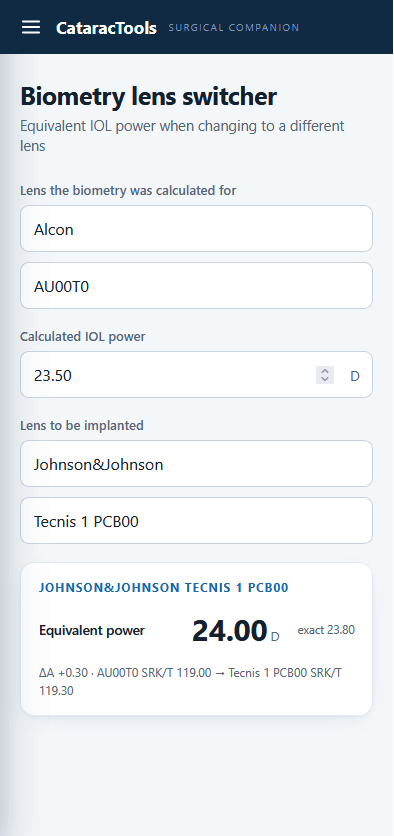
biometry lens switcher

Frequently asked questions

How do I convert IOL power when I switch to a different lens model?

Adjust the planned power by the difference between the two lenses’ constants. The switcher does this for you, preferring the optimised SRK/T constant of each model.

Can I just implant the same power with a different lens?

Only if both lenses share the same constant. If the constants differ, the same labelled power lands at a different refraction, so the power needs converting.

Is a constant-based conversion accurate enough for any eye?

It is a reliable first-order method for the average eye and for intraoperative decisions. In very short or very long eyes, a full recalculation with axial length and keratometry is preferable when time allows.

What if no optimised constant exists for one of the lenses?

The tool falls back to the nominal A-constant and tells you it has done so, so you can judge how much to trust the result.

Constants and further reading

Optimised IOL constants for most current lenses are maintained in the IOLCon database (the successor to the ULIB user group). Using an optimised SRK/T constant rather than the nominal value gives the most reliable conversion.